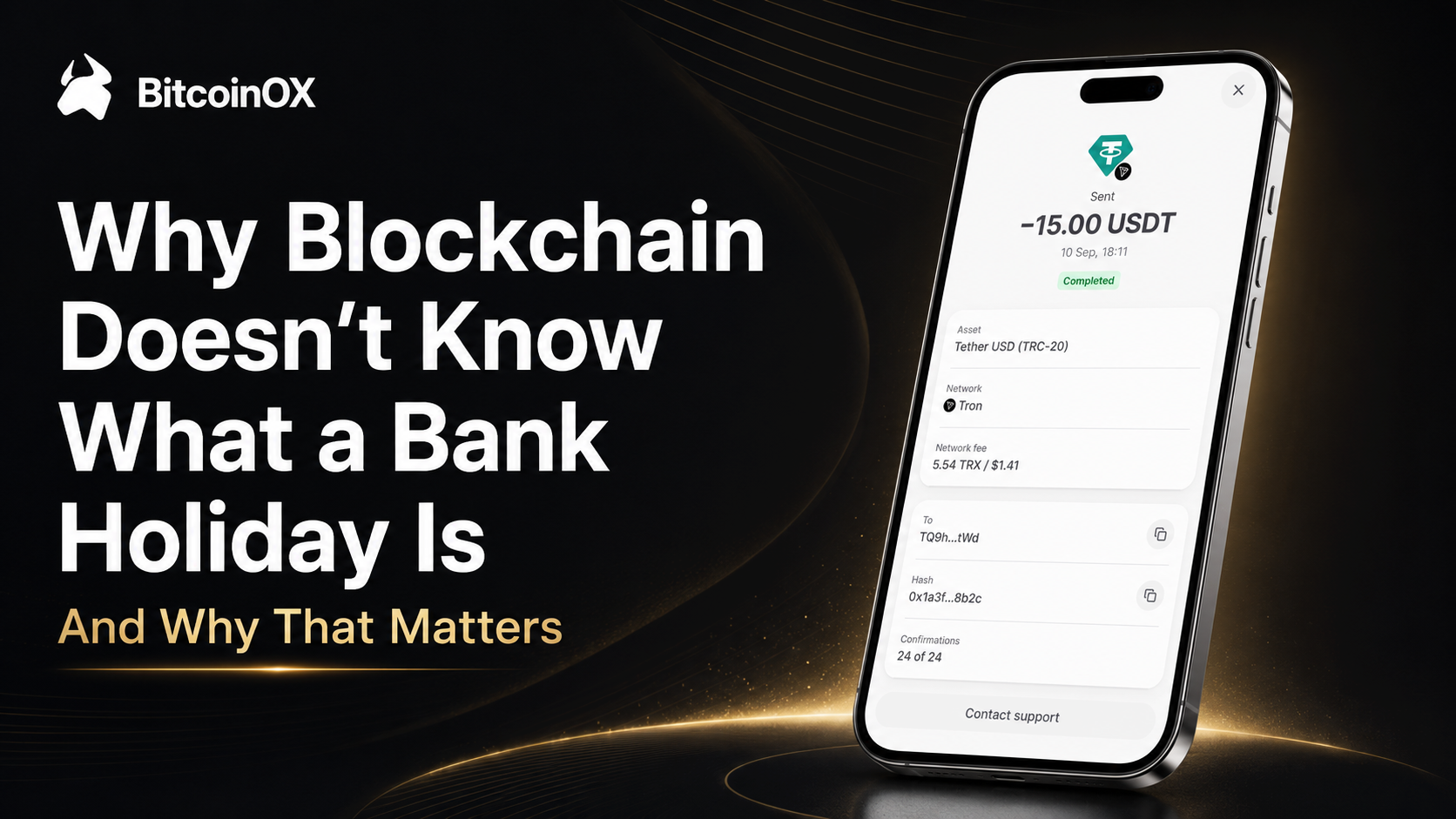
Why Blockchain Payments Don’t Know What a Bank Holiday Is
Blockchain payments are one of the clearest differences between traditional finance and digital assets. Banks, card networks, clearing systems, and local payment rails often operate around business days, weekends, public holidays, cut-off times, and processing windows. Blockchain networks work differently: they do not close for a bank holiday.
That difference matters because money is increasingly global, digital, and time-sensitive. A freelancer may need to receive payment on a Sunday. A traveler may need access to funds while moving between countries. A remote team may need to handle expenses outside local banking hours. In those moments, the gap between traditional payment schedules and blockchain payments becomes very visible.
This does not mean every crypto transaction is instant, free, or risk-free. Blockchain transfers still depend on the network, fees, confirmations, liquidity, wallet compatibility, and compliance requirements. But the underlying idea is powerful: the network itself is not waiting for Monday morning.
Keep Your Assets Moving with BitcoinOX Neo
Manage supported digital assets, transfer crypto, and access crypto-funded payment tools from one mobile-first wallet experience.
Get StartedWhy Bank Holidays Still Affect Digital Money
It is easy to assume that online banking means money moves online all the time. In reality, many traditional payment systems still depend on settlement schedules, banking calendars, clearing windows, and local financial infrastructure. A payment may be initiated inside an app at night, during a weekend, or on a public holiday, but that does not always mean the money is processed or settled immediately.
This is not because banks are secretly trying to delay every payment. It is because much of the traditional financial system was built around institutions, ledgers, business days, and settlement layers that were not originally designed for always-on internet-native money.
That is why blockchain payments matter. Instead of relying on a central banking schedule, blockchain networks process transactions through distributed infrastructure that operates continuously. The network does not need a local branch to open. It does not care if it is Sunday, midnight, or a national holiday.
For additional context, Federal Reserve Financial Services publishes holiday schedules showing how certain payment services operate around public holidays. On the blockchain side, Ethereum.org explains transaction finality and why blockchain settlement still has its own technical timing rules. These resources show the real difference: traditional rails are calendar-based, while blockchain rails are network-based.
What Blockchain Payments Do Differently
A blockchain network is not a bank office, a card issuer, or a local clearing house. It is a distributed ledger maintained by network participants according to protocol rules. Transactions are broadcast, validated, included in blocks, and confirmed according to the design of that specific chain.
This is why blockchain payments are possible outside traditional banking hours. The network continues to operate as long as enough participants keep validating and maintaining it. There is no global “closed” sign for the network itself.
Different blockchains have different speeds, fees, confirmation models, and levels of finality. Bitcoin is not Ethereum. Ethereum is not TRON. Stablecoins, native coins, and token standards may all behave differently depending on the chain. But the core advantage remains: users can initiate supported crypto transfers outside traditional banking hours.
Why Blockchain Payments Matter for Real People
The strongest use case for blockchain payments is not speculation. It is practical access. People increasingly work, earn, travel, subscribe, shop, and collaborate across borders. Their financial tools should not feel stuck in one country’s business calendar.
Freelancers and remote workers
A freelancer working with international clients may not want to wait through a weekend or holiday for a payment to start moving. With compatible wallets, supported assets, and clear payment details, crypto transfers can help make payment flows more direct.
Travelers and digital nomads
Travelers may need flexible access to value while moving between countries and time zones. A wallet connected to supported payment tools can reduce dependence on one local bank account or one domestic payment system.
Global teams and online businesses
International teams may manage contractors, subscriptions, ad accounts, tools, and operational expenses across several regions. Blockchain payments can support payment flows that do not depend entirely on one banking calendar.
Bank Holidays Are Not the Only Delay
Public holidays are only one part of the problem. Traditional payments can also be affected by weekends, cut-off times, intermediary banks, currency conversion steps, risk checks, manual reviews, and settlement cycles.
Crypto does not remove every kind of waiting. A blockchain transaction may still require confirmations. A card top-up may still depend on product rules, supported assets, liquidity, card provider conditions, and compliance checks. A crypto-to-fiat payment may involve conversion and payment network processing.
The difference is that blockchain payments are not built around the same concept of “business hours.” The blockchain network can continue processing transactions even when local banking systems are closed.
How BitcoinOX Neo Fits Into the Always-On Payment Layer
BitcoinOX Neo is designed for users who want a practical way to manage supported crypto assets and connect them with real-world payment tools. The product combines a multi-chain crypto wallet, crypto-funded card functionality, virtual and physical card options where available, and mobile-first wallet management.
That makes BitcoinOX Neo relevant for users who care about blockchain payments but still need practical spending options. Holding crypto is useful. Moving crypto is useful. But using crypto for online purchases, subscriptions, travel-related expenses, and international payments is where the wallet becomes part of daily life.
For users who want more detail, the BitcoinOX Neo FAQ explains how the product connects wallet storage, crypto-funded cards, fiat payments, and international payment flexibility.
The Role of Crypto-Funded Cards
One common misunderstanding is that blockchain payments only mean sending coins from one wallet address to another. That is one part of the picture. The broader value comes when supported crypto assets can connect to payment tools people already use.
Crypto-funded cards can help bridge digital assets and traditional card payment infrastructure. A user may hold supported assets in a wallet, top up a card balance where available, and use that card for payments in fiat currency at compatible online or offline merchants.
This does not mean the card network itself becomes a blockchain. It means the user can access value from supported crypto assets without manually moving through several separate platforms every time. That is where blockchain payments and card-based spending can work together.
Security Still Comes First
Always-on access is useful only if users treat it responsibly. Before sending or using crypto, check the basics carefully:
- Confirm the recipient wallet address before sending.
- Check the correct blockchain network for the asset.
- Review network fees before confirming a transfer.
- Use trusted devices and avoid suspicious payment links.
- Never share your seed phrase, private key, or recovery phrase.
- Keep payment records for tax, accounting, or business documentation where required.
If you use a self-custody wallet, private key control becomes especially important. The BitcoinOX guide to private key crypto wallet ownership explains why seed phrases and private keys must be protected carefully.
Blockchain Payments Are Always-On, Not Rule-Free
Blockchain payments should not be confused with payments without rules. Crypto products, card access, fiat conversion, KYC verification, AML checks, and supported jurisdictions can all affect what a user can do.
This is an important distinction. The blockchain network may not observe bank holidays, but regulated payment products still need to follow applicable requirements. That is why responsible crypto payment messaging should avoid phrases like “no questions asked” or “no checks.” Those phrases create the wrong impression and do not fit serious payment products.
A better way to think about it is this: blockchain can reduce dependence on traditional banking schedules, while compliant wallet and card products help connect digital assets with everyday payment use cases.
Why the Gap Is Growing
Traditional finance is also moving toward faster payment systems, real-time settlement, and wider operating hours. But many rails still need to coordinate across institutions, jurisdictions, risk systems, and legacy infrastructure.
Blockchain started from a different design principle. It was built for network-native value transfer, not branch hours. That is why blockchain payments feel natural to crypto users and disruptive to systems built around business days.
The more global and remote-first the economy becomes, the more visible this difference gets. Money does not only move Monday to Friday anymore. People work across time zones. Teams hire globally. Travelers buy services across borders. Digital subscriptions renew at any hour. Payment tools need to match that reality.
Final Takeaway
Blockchain does not know what a bank holiday is because it does not operate like a bank. It is a network, not a branch calendar. That is why blockchain payments matter for freelancers, travelers, digital nomads, international teams, and anyone who wants more flexible access to supported digital assets.
The advantage is not that crypto removes every delay, fee, or requirement. It does not. The advantage is that blockchain networks are always available at the infrastructure level, while wallet and payment products like BitcoinOX Neo can help users turn that always-on access into practical financial tools.
Move Crypto on Your Schedule
Create your BitcoinOX Neo wallet, manage supported assets, and access crypto-funded payment tools designed for global digital payments.
Get StartedFAQ
Do blockchain payments work on bank holidays?
Yes. Blockchain payments can be initiated outside banking hours, including weekends and public holidays, as long as the relevant blockchain network is operating and the transaction meets network requirements.
Are blockchain payments instant?
Not always. Transaction speed depends on the blockchain, network congestion, fees, confirmations, and wallet or platform processing rules. Always-on does not always mean instant.
Can I use BitcoinOX Neo outside bank hours?
BitcoinOX Neo is designed as a mobile-first crypto wallet and payment platform, so users can manage supported digital assets and access available wallet features beyond traditional banking hours. Card, fiat, and verification features may depend on region and provider rules.
Why do bank holidays affect traditional payments?
Many traditional payment systems still depend on banking calendars, clearing windows, settlement schedules, and institutional processing times. This can affect when certain transfers are processed or settled.
Is using crypto during bank holidays compliant?
Using crypto outside banking hours does not remove compliance responsibilities. Users should follow local rules, complete required verification, keep records, and use crypto payment tools for legitimate transactions.
Why are blockchain payments useful?
Blockchain payments are useful because they let users initiate supported crypto transfers beyond traditional banking hours, making them relevant for international payments, remote work, travel, and global digital spending.
Keep Your Crypto Moving on Your Schedule
Manage supported digital assets, access crypto-funded payment tools, and use BitcoinOX Neo beyond traditional banking hours.
Get Started