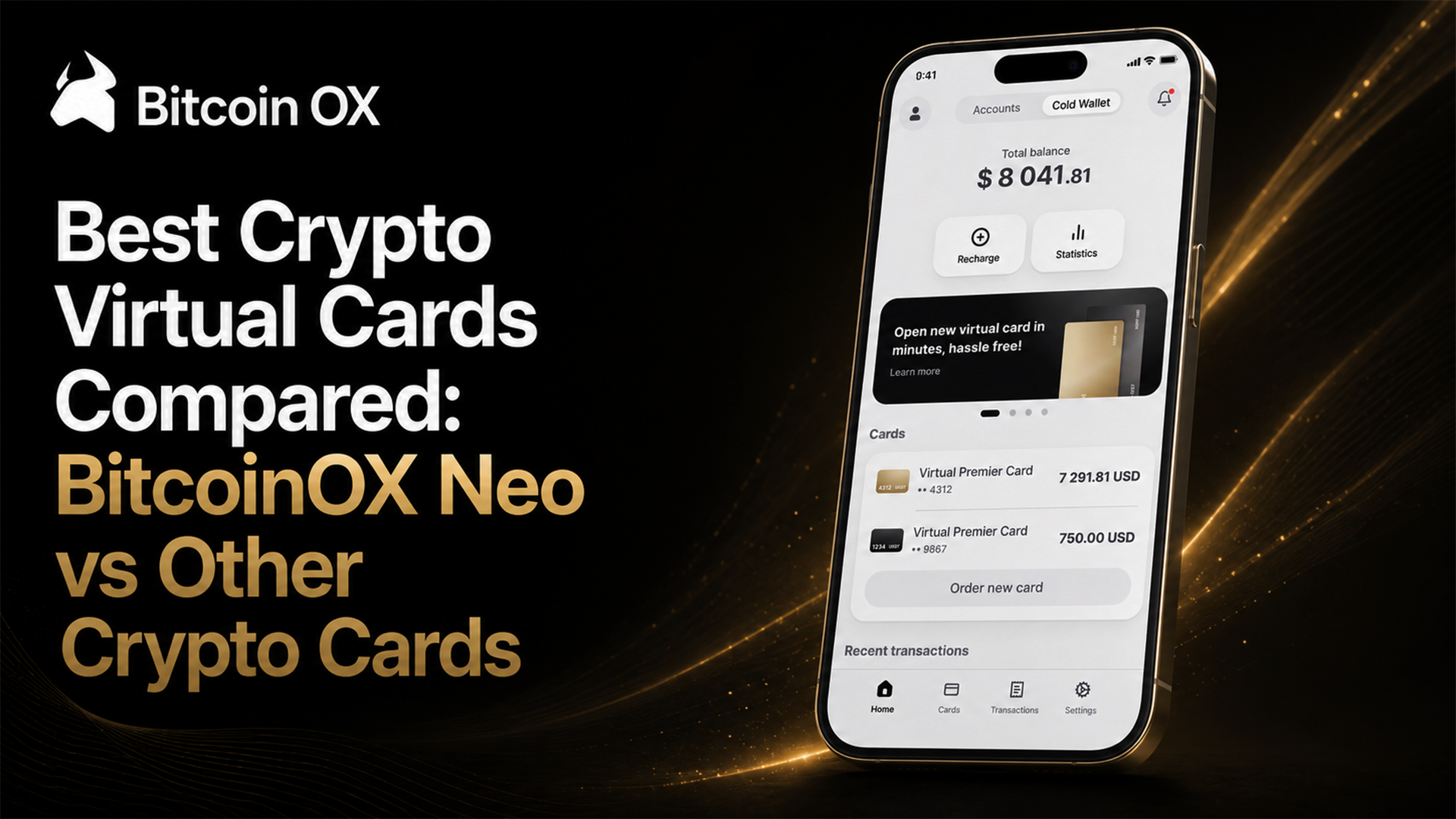
Best Crypto Virtual Card Comparison: BitcoinOX Neo vs Other Crypto Cards
A crypto virtual card is one of the most practical ways to turn supported digital assets into everyday online payments. Instead of keeping crypto only as a balance in a wallet, users can connect it to card-based spending for subscriptions, travel bookings, digital tools, advertising accounts, and other online purchases where supported.
But crypto cards are not all built the same way. Some focus on rewards. Some focus on Apple Pay or Google Pay compatibility. Some are tied to specific regions, paid tiers, card issuance fees, monthly costs, or minimum balance requirements. Others are designed to make virtual card access simpler.
This comparison looks at BitcoinOX Neo alongside Antarctic Wallet and several other card products discussed in the market, including Crypto.com, UPay, Bista, CoinJar, and Trastra. The goal is not to claim one universal winner. The goal is to help users compare fees, use cases, supported assets, verification requirements, and the real value of free virtual card issuance.
Get a Free Virtual Card with BitcoinOX Neo
Start with a mobile-first crypto wallet, complete the required verification, and access eligible virtual card issuance without a separate issuance fee.
Get StartedWhat Makes a Crypto Card Worth Using?
The best card is not always the one with the biggest rewards headline. For most users, practical details matter more than marketing claims. Before choosing a crypto virtual card, compare the product against your real spending needs.
- Issuance cost: whether the virtual card is free, paid, or tied to a minimum deposit.
- Supported assets: which cryptocurrencies can be used to fund or manage spending.
- Card format: virtual card, physical card, prepaid card, debit card, or premium card.
- Payment networks: Visa, Mastercard, UnionPay, Apple Pay, Google Pay, or other supported rails.
- Regional availability: whether the product is available in the user’s country.
- Verification requirements: KYC level, limits, and compliance checks.
- Fees and limits: top-up fees, conversion fees, FX fees, monthly fees, ATM fees, and spending limits.
- Wallet experience: whether the card is part of a broader crypto wallet or only a spending tool.
For many users, the first question is simple: how much does it cost to start? This is where BitcoinOX Neo’s free virtual card issuance becomes a clear advantage for eligible users who want to try card-based crypto spending without paying a separate issuance fee upfront.
Crypto Card Comparison Table
| Provider | Best for | Virtual card issuance | Supported assets / currencies | Key strengths | Things to check before using |
|---|---|---|---|---|---|
| BitcoinOX Neo | Users who want a crypto wallet plus virtual card access in one product | Free virtual card issuance for eligible users | Multiple supported digital assets and card currencies where available | Free virtual issuance, wallet functionality, multi-currency cards, virtual and physical options, crypto-to-card usage | Availability, verification level, supported assets, limits, and provider conditions may vary by region |
| Antarctic Wallet | Users who want QR payments, USDT or TON wallet usage, and local payment scenarios | Registration and Basic verification are required for card issuance | USDT, TON, QR payment flows, and local payment scenarios where supported | QR payments, virtual Mastercard, card top-up, withdrawal to card, mobile app and Telegram bot access | Regional coverage, supported countries, local currency corridors, limits, and verification requirements |
| Crypto.com Card | Users who want a large ecosystem with tiers, rewards, and premium benefits | Depends on market, tier, and current product conditions | Multiple supported digital assets and funding options depending on region | Large ecosystem, rewards, premium tiers, strong brand recognition | Staking or tier requirements, changing rewards, regional fees, and benefit availability |
| UPay | Users looking for international virtual card options and higher limits | Some public materials list paid issuance for selected products | Digital asset balance and card spending depending on selected card type | Virtual card options, high limits on some tiers, international positioning | Issuance fees, funding requirements, supported countries, card type, and withdrawal limitations |
| Bista Card | European users who need EUR-based card spending | Virtual card availability depends on product tier and conditions | Multiple crypto assets with EUR-based card usage | Virtual and physical options, European positioning, multi-crypto support | Monthly fees on higher tiers, conversion fees, FX fees, limits, and country availability |
| CoinJar Card | Users in supported regions who want a simple prepaid card model | Availability and pricing depend on market | BTC, ETH, stablecoins, and other supported assets depending on region | Simple prepaid card experience, no monthly or annual fees in some regions | Purchase fees, FX fees, regional limits, ATM rules, and availability |
| Trastra Card | European users who want EUR card usage and IBAN-related functionality | Card issuance is paid according to public fee materials | Major crypto assets with EUR card usage | EUR focus, Visa card, IBAN-related features, European positioning | Issuance cost, annual or monthly fees, ATM fees, cross-border fees, and EEA availability |
Where BitcoinOX Neo Stands Out
BitcoinOX Neo’s strongest advantage in this comparison is straightforward: eligible users can issue a crypto virtual card without a separate virtual card issuance fee. For users comparing card products, that matters because many providers introduce friction before the user even starts spending.
Some competitors emphasize rewards but tie their best benefits to higher tiers, subscriptions, staking, or premium plans. Others focus on local payment corridors, QR payments, or region-specific card access. BitcoinOX Neo is positioned differently: it combines wallet functionality, supported digital asset management, virtual and physical card access, and crypto-funded payment tools in one mobile-first experience.
That makes BitcoinOX Neo especially relevant for users who want a practical card-first setup without losing the wallet layer. The card is not isolated from the wallet. It is part of a broader product experience designed for crypto storage, transfers, card funding, and global payments.
BitcoinOX Neo vs Antarctic Wallet
Antarctic Wallet is built strongly around QR payments, USDT or TON balance usage, local payment flows, and wallet access through both mobile apps and a Telegram bot. Its website also highlights virtual cards, QR payments, card top-up, withdrawal to card, mass transfers, and AML checks.
BitcoinOX Neo is more card-and-wallet oriented. It emphasizes multi-currency cards, supported Visa, Mastercard, and UnionPay card networks, virtual and physical card types, card funding, internal transfers, and a self-custody wallet approach. For users who mainly need QR payments in supported corridors, Antarctic Wallet may be relevant. For users who want a crypto virtual card connected to a broader wallet and card setup, BitcoinOX Neo is the cleaner fit.
The key comparison point is the starting experience. If a user wants fast access to a virtual card and does not want to pay an issuance fee for an eligible card, BitcoinOX Neo’s free virtual card issuance is a clear advantage.
BitcoinOX Neo vs Crypto.com, UPay, Bista, CoinJar, and Trastra
The broader crypto card market is diverse. Crypto.com is known for its large ecosystem, card tiers, rewards, and premium benefits. UPay positions virtual cards for international users and higher card limits. Bista focuses on EUR-based card usage and European markets. CoinJar offers a prepaid card model in supported regions. Trastra is more Europe-focused and connected with EUR card usage and IBAN-related features.
These products can be useful, but they are not identical. A rewards-focused card may not be the best choice for someone who simply wants a free virtual card. A European card may not help a user outside the supported region. A high-limit option may come with issuance costs, funding requirements, or limitations on ATM withdrawals. A physical card may be useful for travel, but unnecessary for a user who mainly pays online.
This is why the best crypto virtual card depends on the user’s actual payment scenario. For subscriptions, online services, digital tools, advertising accounts, and everyday online payments, free virtual issuance can be more valuable than premium perks that only apply to high-tier users.
Free Virtual Card Issuance: Why It Matters
Card issuance cost is easy to overlook, but it shapes the first user experience. If a card requires an issuance fee, paid tier, subscription, minimum deposit, or high-tier unlock, the user has to make a commitment before knowing whether the product fits their needs.
A free virtual card lowers that barrier. It lets users start with a practical payment tool, test supported card usage, and understand how the wallet-to-card flow works before committing to a broader setup.
For BitcoinOX Neo, free virtual card issuance is not just a pricing detail. It is part of the product positioning: easier card access, practical crypto spending, and a mobile-first experience for users who want to move from holding crypto to actually using it.
Virtual Card vs Physical Crypto Card
A virtual card is usually best for online payments, subscriptions, app stores, digital services, ads, SaaS tools, travel bookings, and quick card setup. A physical card is better when users need in-store payments, ATM access, or travel spending in locations where physical cards are still more convenient.
The strongest crypto card platforms offer both options. BitcoinOX Neo supports virtual and physical card use cases where available, which makes it more flexible than products focused only on one card format.
For many users, the virtual card is the best starting point. It can be issued faster, used for online spending, and managed directly from the wallet interface. That is why a free crypto virtual card can be such a strong onboarding advantage.
Security and Compliance Still Matter
A crypto card should never be evaluated only by issuance cost. Users should also look at security, verification, card controls, wallet design, and transparency.
BitcoinOX Neo emphasizes private key control, self-custody wallet architecture, encryption, two-factor authentication, secure communication protocols, and multi-chain support. This wallet layer matters because the card experience is only one part of the product. Users also need confidence in how supported assets are stored, managed, transferred, and used.
At the same time, responsible crypto card products require verification and compliance checks where applicable. A free virtual card should not be confused with a no-rules product. Card access, limits, fiat usage, supported currencies, KYC level, and regional availability can all depend on provider rules and applicable requirements.
How to Choose the Best Card for Crypto Spending
Before choosing a crypto virtual card, use this simple checklist:
- Start with your use case: online subscriptions, travel, ads, everyday payments, or business expenses.
- Check issuance cost: free, paid, subscription-based, or tier-based.
- Review supported assets: BTC, ETH, USDT, stablecoins, or other supported coins.
- Confirm card network: Visa, Mastercard, UnionPay, Apple Pay, Google Pay, or other compatibility.
- Read the fee schedule: top-up, conversion, FX, monthly, ATM, and replacement fees.
- Check regional availability: cards are often restricted by country or residency.
- Review verification requirements: KYC level, limits, and account status.
- Look beyond rewards: premium rewards may not matter if the card is expensive or unavailable.
If your priority is easy online spending with a card connected to a crypto wallet, BitcoinOX Neo is a strong option to evaluate. If your priority is QR payment corridors, Antarctic Wallet may be more relevant. If your priority is premium rewards, Crypto.com-style tiered cards may be worth reviewing. If your priority is EUR-based card usage, Bista or Trastra may be more relevant depending on your location.
Sources and Market Context
This comparison is based on publicly available product information from Antarctic Wallet, broader market context from a Binance Square overview of crypto card options, and BitcoinOX Neo product information published on the BitcoinOX website.
Final Verdict: Which Crypto Card Should You Choose?
There is no single best crypto card for every user. The right product depends on where you live, how you spend, which assets you hold, whether you need a virtual or physical card, and how much you are willing to pay before you start.
BitcoinOX Neo stands out because it connects a crypto wallet, supported digital assets, virtual and physical card functionality, and free virtual card issuance for eligible users. That combination makes it especially attractive for users who want a practical crypto virtual card without paying a separate issuance fee upfront.
Other cards may offer rewards, higher limits, regional payment corridors, IBAN features, or premium perks. Those can be valuable for the right user. But for everyday online payments, subscriptions, travel tools, and crypto-to-card spending, starting with a free virtual card can be the most practical first step.
Start with a Free BitcoinOX Neo Virtual Card
Create your wallet, complete the required verification, and access eligible virtual card issuance for practical crypto-powered payments.
Get StartedFAQ
What is a crypto virtual card?
A crypto virtual card is a digital payment card that lets users spend supported crypto-funded balances through compatible card payment networks, usually for online purchases, subscriptions, and digital services.
Is BitcoinOX Neo virtual card issuance free?
BitcoinOX Neo offers free virtual card issuance for eligible users after the required onboarding and verification steps. Availability, limits, supported currencies, and provider conditions may vary.
How is BitcoinOX Neo different from Antarctic Wallet?
Antarctic Wallet focuses heavily on QR payments, USDT or TON balance usage, and local payment corridors. BitcoinOX Neo focuses more on multi-currency cards, wallet functionality, card funding, and virtual or physical card use cases.
Are crypto cards available everywhere?
No. Crypto card availability depends on provider rules, supported countries, card networks, verification requirements, and local regulations.
Do crypto cards require KYC?
Most serious crypto card products require some level of identity verification before card issuance or higher spending limits. Requirements vary by provider and jurisdiction.
Which crypto virtual card is best?
The best crypto virtual card depends on the user’s needs. BitcoinOX Neo is a strong fit for users who want free virtual card issuance, wallet functionality, supported card tools, and practical crypto spending in one product experience.
Start with a Free BitcoinOX Neo Virtual Card
Create your wallet, complete the required verification, and access eligible virtual card issuance for practical crypto-powered payments.
Get Started