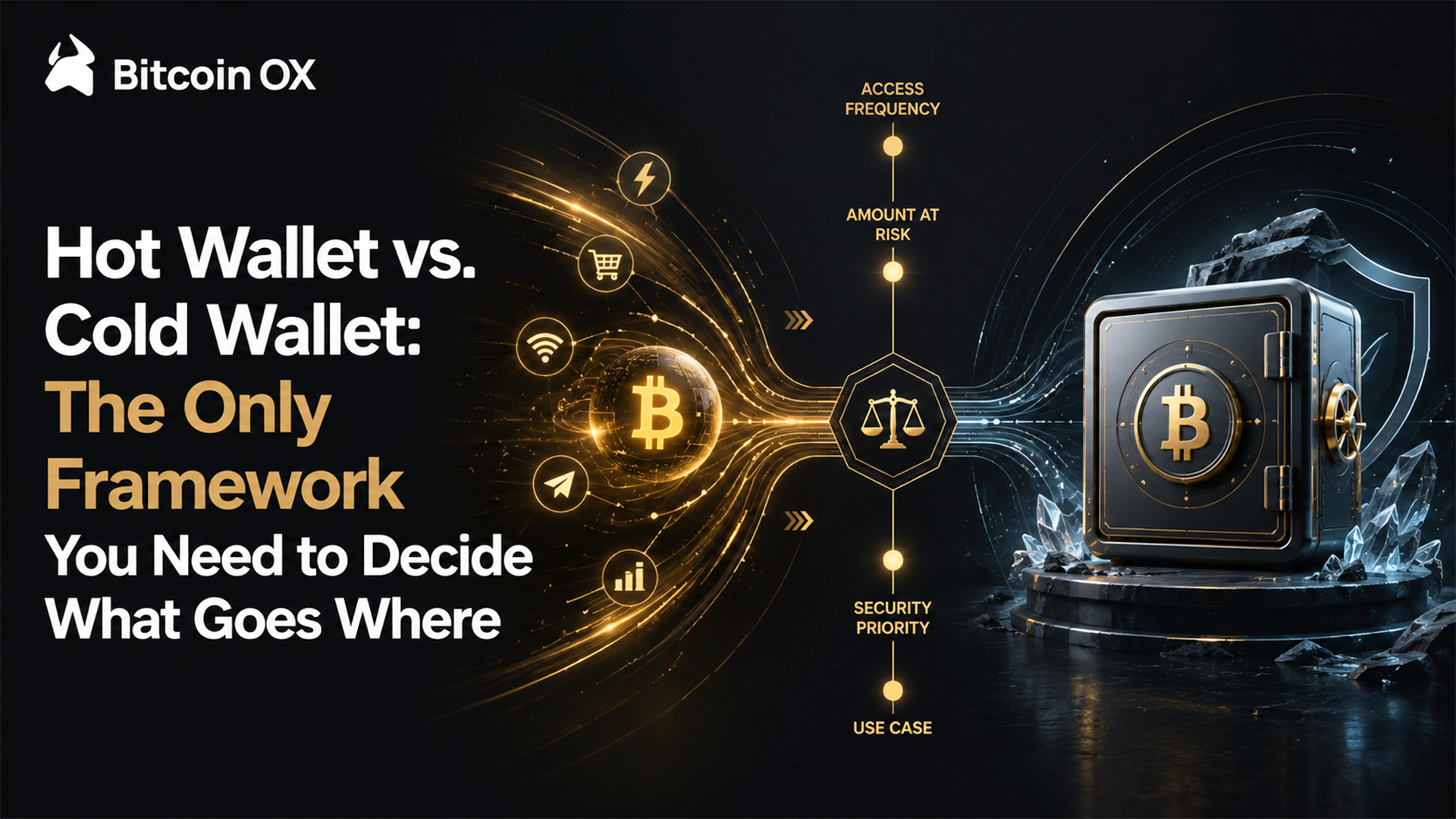
Hot Wallet vs Cold Wallet: The Only Framework You Need to Decide What Goes Where
Hot wallet vs cold wallet is not really a debate. It is a storage habit. A hot wallet is useful for everyday access, sending payments, topping up a card, and managing smaller working balances. A cold wallet is better suited for assets you do not plan to touch often.
The easiest way to understand it is the pocket wallet and home safe analogy. You do not carry every important document and every long-term saving in your pocket. You keep enough for daily use nearby, and you keep long-term value in a more protected place.
Crypto works the same way. The question is not which wallet is best. The better question is: what should go where? This article gives you a simple framework for deciding how to split spending funds, emergency funds, long-term holdings, and active crypto balances between hot and cold storage.
Start with BitcoinOX Neo
Manage supported digital assets, access wallet tools, and use crypto-funded payment features from one mobile-first experience.
Get StartedWhat Is a Hot Wallet?
A hot wallet is a crypto wallet connected to the internet. It may be a mobile app, browser wallet, desktop wallet, exchange wallet, or another online wallet interface. Its main advantage is access. You can send, receive, connect, top up, and manage funds quickly.
This makes a hot wallet useful for daily crypto activity. If you pay for subscriptions, transfer funds, use a crypto card, interact with apps, or move assets frequently, you need an online wallet experience that is convenient enough to use.
But convenience comes with exposure. Because a hot wallet is used on an online device, users must take device security, phishing protection, seed phrase safety, app authenticity, and transaction review seriously. A hot wallet is not automatically unsafe, but it should not become the place where every asset lives by default.
What Is a Cold Wallet?
A cold wallet is a wallet setup designed to reduce online exposure of private keys or wallet credentials. It may involve a hardware wallet, offline signing setup, air-gapped device, paper backup, or another method that keeps signing authority away from regular internet-connected use.
The purpose of cold storage is not convenience. The purpose is separation. Long-term holdings, savings, or assets that do not need to move often can be kept away from daily online activity.
That is why the hot wallet vs cold wallet decision should start with usage. If funds need frequent access, they usually fit the hot side. If funds are meant to sit untouched, they usually belong closer to cold storage.
The Only Framework You Need: Spend, Buffer, Save
The cleanest way to decide what goes where is to divide your crypto into three buckets: spend, buffer, and save. This simple model keeps the hot wallet vs cold wallet conversation practical instead of theoretical.
1. Spend
This is the crypto you expect to use soon. It may fund card payments, subscriptions, online purchases, transfers, or small daily transactions. This bucket belongs in a hot wallet or payment-ready wallet setup because access matters.
2. Buffer
This is your short-term reserve. It is not daily spending, but it may need to move within days or weeks. Some users keep this in a separate hot wallet, a lower-frequency wallet, or a more controlled wallet setup depending on their risk tolerance.
3. Save
This is long-term storage. If you do not plan to use the funds soon, they do not need to sit in the same environment as your everyday payments. This bucket usually belongs in cold storage or a cold-wallet-oriented setup.
This framework is simple, but it changes behavior. Instead of asking one wallet to do everything, you give every balance a job. Spending funds stay accessible. Long-term assets stay less exposed. The user stops treating wallet choice as a brand preference and starts treating it as operational hygiene.
What Should Go in a Hot Wallet?
A hot wallet is best for assets that need movement. The amount depends on the user, but the category is usually clear: funds you may need soon.
- Everyday crypto spending: small balances for online purchases, subscriptions, or app payments.
- Crypto card top-ups: supported assets intended for card-based spending.
- Small transfers: funds used for sending money to friends, contractors, or other wallets.
- Testing transactions: smaller amounts used to confirm address, network, and wallet behavior.
- Active balances: crypto you expect to move, convert, or use in the near term.
For BitcoinOX Neo users, this is where the wallet and payment layer connect. BitcoinOX Neo is designed to help users manage supported assets and use crypto-funded card tools where available. That makes it relevant for the spend bucket: funds that need practical access, not funds that should sit untouched for years.
What Should Go in a Cold Wallet?
Cold storage is best for assets that do not need frequent movement. These balances should not be exposed to everyday browsing, app downloads, social messages, unknown links, or payment mistakes.
- Long-term holdings: assets intended to remain untouched for months or years.
- Savings: funds that should not be part of daily payment activity.
- Large balances: amounts that would create serious damage if compromised.
- Backup reserves: funds meant to stay separate from active spending wallets.
- Cold storage allocations: assets stored with stronger separation from online devices.
The point is not that cold wallets are magic. They also require discipline. A lost seed phrase, damaged backup, incorrect recovery process, or careless signing habit can still create problems. Cold storage reduces one class of exposure, but it does not replace user responsibility.
Hot Wallet vs Cold Wallet: A Practical Decision Table
Use this quick framework when deciding where a specific balance belongs.
Use a hot wallet when:
- you expect to spend or transfer the funds soon;
- you need access from a phone or app;
- the balance is small enough for daily-use risk;
- you need to top up a card or manage payment activity;
- you are actively testing a transaction, address, or network.
Use cold storage when:
- you do not plan to move the funds often;
- the balance is large relative to your personal risk tolerance;
- you want stronger separation from online devices;
- the assets are long-term savings;
- you can safely manage backups and recovery procedures.
This is the heart of the hot wallet vs cold wallet framework: access and exposure move in opposite directions. The more access you want, the more carefully you must manage online risk. The less often you need access, the more sense cold storage makes.
How BitcoinOX Neo Supports Both Approaches
BitcoinOX Neo is built around practical crypto management. The product combines wallet access, supported digital asset management, cold wallet security principles, virtual and physical payment card tools where available, and mobile-first usability.
This matters because most users do not live entirely in one mode. They need some funds available for payments, and they need other funds stored with stronger separation. BitcoinOX Neo supports this practical split by helping users manage supported crypto assets while keeping wallet security and private key control central to the experience.
For everyday needs, users may want a wallet that can connect crypto balances to card-funded payments. For long-term holdings, users may want a more conservative storage habit that reduces unnecessary online exposure. A strong wallet strategy can include both.
Private Keys Are the Real Security Boundary
The hot wallet vs cold wallet conversation often becomes too focused on the device type. The deeper question is where private keys or signing authority are stored and how often they touch online environments.
If a wallet can sign transactions from an internet-connected device, the user gets convenience. If signing authority stays offline or separated from daily activity, the user gets stronger isolation. Neither choice is automatically right for every balance. The right answer depends on the job of the funds.
BitcoinOX Neo emphasizes private key control and wallet security. For more background, read the BitcoinOX Neo FAQ and the BitcoinOX guide to private key crypto wallet ownership.
Common Mistakes When Splitting Hot and Cold Wallets
Mistake 1: Keeping everything in one hot wallet
This is convenient until it is not. A daily-use wallet is exposed to more interactions, more links, more devices, more payments, and more opportunities for user error. It should usually hold only what needs daily access.
Mistake 2: Making cold storage too hard to recover
Cold storage should be secure, but not impossible for the owner to recover. If backups are lost, unclear, damaged, or stored without a plan, the user may create a different kind of risk.
Mistake 3: Moving funds without a test transaction
When moving meaningful amounts, a small test transaction can help confirm the address, network, and wallet flow before sending the full amount.
Mistake 4: Confusing exchange accounts with wallet control
An exchange account may be convenient, but it is not the same as controlling private keys in a self-custody wallet. Users should understand who controls the keys and what happens if access is restricted.
Mistake 5: Treating cold storage as risk-free
Cold storage reduces online exposure, but it still requires careful backups, secure recovery procedures, physical protection, and disciplined transaction signing.
Security Checklist for Hot and Cold Wallet Use
A good wallet strategy is not only about choosing the right category. It is about maintaining safe habits over time.
- Keep only active-use balances in a hot wallet.
- Move long-term holdings to a cold-wallet-oriented setup when appropriate.
- Never share seed phrases, private keys, or recovery phrases.
- Verify every wallet address and blockchain network before sending funds.
- Use strong authentication and secure devices for active wallets.
- Store backups offline and protect them from loss, damage, or unauthorized access.
- Use small test transactions when moving meaningful amounts.
- Review wallet permissions, app sources, and update channels carefully.
These habits are simple, but they make the hot wallet vs cold wallet split much more effective. The goal is not to create fear. The goal is to make wallet decisions match real usage.
Sources and Technical Context
For neutral terminology, NIST describes hot wallets as internet-connected and cold wallets as not connected to the internet. For additional background, Ledger explains cold wallets as systems that keep private keys offline, and Uniswap Labs explains common wallet types and private key access.
Example Wallet Split for Everyday Users
There is no universal percentage split that works for everyone. But the logic below can help users build their own model.
Daily spending
Keep a smaller amount in a hot wallet for payments, subscriptions, transfers, and card-related activity. This balance should be useful enough to avoid constant transfers, but not so large that it creates unnecessary exposure.
Short-term reserve
Keep a separate buffer for funds that may be needed soon but are not part of daily spending. Some users keep this in a more controlled wallet setup or move it only when needed.
Long-term storage
Keep savings or long-term holdings in cold storage or a cold-wallet-oriented setup. Access should be more deliberate, with backups and recovery procedures planned in advance.
This approach turns hot wallet vs cold wallet from a theoretical debate into a working system. Every balance gets a purpose, and every purpose gets the right level of access.
Final Takeaway
Hot wallet vs cold wallet is not about choosing one forever. It is about matching access to purpose. Funds you expect to spend belong closer to a hot wallet. Funds you expect to save belong closer to cold storage.
The strongest crypto users usually do not rely on one wallet habit for everything. They separate daily access from long-term storage. They keep private keys protected. They avoid putting every balance in the same risk environment.
BitcoinOX Neo supports this practical mindset by combining wallet access, supported asset management, cold wallet security principles, and crypto-funded payment tools where available. Start with the balance you actually need to use, then decide what should stay offline or more protected.
Build a Smarter Wallet Strategy with BitcoinOX Neo
Use a mobile-first wallet experience for supported assets, practical crypto payments, and stronger separation between daily spending and long-term holdings.
Get StartedFAQ
What is the main difference between a hot wallet and a cold wallet?
A hot wallet is connected to the internet and is usually better for frequent access. A cold wallet is designed to reduce online exposure and is usually better for long-term storage.
Is a hot wallet safe?
A hot wallet can be safe when used carefully, but it is more exposed because it operates on an internet-connected device. Users should protect seed phrases, avoid phishing links, verify transactions, and keep only appropriate balances in daily-use wallets.
Is a cold wallet risk-free?
No. A cold wallet reduces online exposure, but it still requires careful backup, recovery, physical protection, and secure signing habits.
How much crypto should I keep in a hot wallet?
There is no universal amount. A practical rule is to keep only what you may need for near-term payments, transfers, card top-ups, or active wallet use.
What should go into cold storage?
Long-term holdings, savings, and larger balances that do not need frequent access are usually better suited for cold storage or a cold-wallet-oriented setup.
Does BitcoinOX Neo support hot and cold wallet habits?
BitcoinOX Neo is designed around practical crypto management, wallet access, private key control, cold wallet security principles, and crypto-funded payment tools where available. Users can build a strategy that separates active spending from longer-term storage.
What is the best hot wallet vs cold wallet framework?
The best hot wallet vs cold wallet framework is to separate funds by purpose: spend, buffer, and save. Spending funds need access, buffer funds need controlled flexibility, and long-term savings need stronger separation.
Start with What Fits Your Crypto Routine
Use BitcoinOX Neo to manage supported assets, access payment tools, and build a smarter split between daily use and long-term storage.
Get Started